
6711 East Marshville Blvd., Marshville, NC, 28103
|
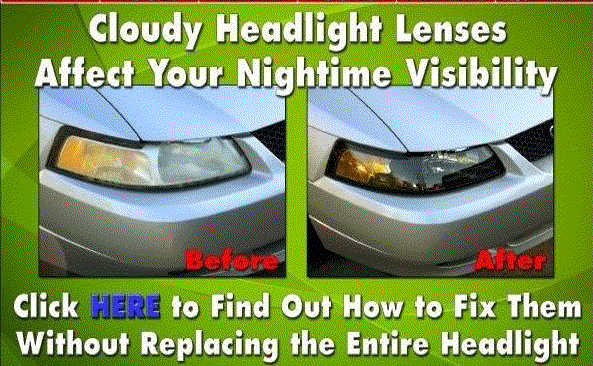
Get those cloudy Headlights restored to like newcondition for a fraction of the price!
Thu, 14 May 2015 AAA Tests Show Headlight Limitations Increase Crash Likelihood
New test results from AAA reveal that modern headlights may not adequately illuminate roads without overhead lighting, potentially creating a greater likelihood of crashes of up to 40 percent of vehicle miles traveled. The study also showed benefits from having older headlights lenses restored.
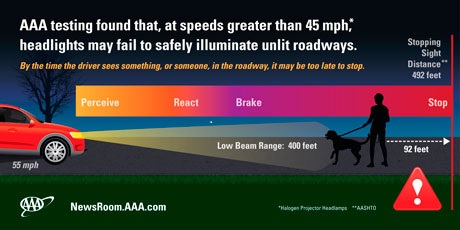
AAA’s test results suggest that halogen headlights, found in more than 80 percent of vehicles on the road today, may fail to safely illuminate unlit roadways at speeds as low as 40 mph. These roads are typically rural, but account for 40 percent of all vehicle miles traveled annually.
AAA Headlight Testing
The testing, conducted with the Automobile Club of Southern California’s Automotive Research Center (ARC), measured the distances at which modern headlights illuminate non-reflective objects on both low-beam and high-beam settings. These findings, paired with guidelines issued by the American Association of State Highway and Transportation Officials, indicate that when traveling on unlit roadways, today’s headlights fail to light the full distance necessary for a driver to detect an object or obstacle in the roadway, react and come to a complete stop.
The research center compared the performance of three types of headlights: halogen, high intensity discharge (HID) and light-emitting diode (LED). Of the three types of headlights, halogen performed the worst.
“AAA’s test results reveal that headlights found in U.S. vehicles fall short on safety,” said Megan McKernan, manager of the Auto Club’s ARC. “By failing to properly light roadways at moderate speeds, a pedestrian or animal may not become visible to a driver until it’s too late to stop.”
While high-beam settings on halogen headlights improved sight distances by 28 percent at the testing facility, in real-world conditions they may only provide enough light to safely stop at speeds of up to 48 mph, leaving drivers vulnerable at highway speeds. Despite the clear need for the additional visibility that high-beams offer, particularly on unlit roads, a recent AAA survey found that only a third of Americans admit to using these settings regularly.
Additional testing found that while the advanced headlight technology found in HID and LED headlights illuminated dark roadways 25 percent further than their halogen counter-parts, they still may fail to fully illuminate roadways at speeds greater than 45 mph. High-beam settings on these advanced headlights offered significant improvement over low-beam settings, lighting distances of up to 500 feet (equal to 55 mph). Despite the increase, even the most advanced headlights fall 60 percent short of the sight distances that the full light of day provides.
“While it’s encouraging to see the safety benefit that newer headlight technology offers to drivers, there’s still room for improvement,” said AAA’s Managing Director of Automotive Engineering and Repair John Nielsen. “Unlike the more advanced headlight technology available in European vehicles, current government regulations limit the light output for vehicles sold in the United States. AAA looks forward to working with U.S. policy makers to ensure federal regulations keep up with changing technology.”
Headlight Restoration In addition to testing low-beam and high-beam headlight performance, AAA tested the effect that deteriorated headlight lenses have on light intensity and glare. The protective coating used on the plastics of modern lenses can slowly deteriorate and cloud after about 5 years, reducing light output and increasing light scatter, which results in glare for other drivers. Testing found that restoring headlights doubles the maximum light intensity and reduces glare-producing light scatter by up to 60 percent. Yet, according to a recent AAA survey, only 20 percent of Americans have performed this service.
“Deteriorated or dirty headlight lenses are not just an aesthetic issue,” warned Nielsen. “An annual service on older vehicles will increase your nighttime visibility and minimize distracting glare for fellow drivers.”
|
| Navigation | |
| Testimonial | |
|
"You guys are the best. When I was involved in an accident with my 2000
Honda Accord which was hit in the rear, I didn't think it would ever look the same, but you are
the BEST! My car looks like new again and the Chroma flames are awesome."
-- Christian K., US |
Copyright 2021 APCR